
Lion’s Mane Mushroom: How This Fungi May Actually Rewire Your Brain
Lion's Mane mushroom crosses the blood-brain barrier to stimulate nerve growth and support brain health through scientifically-documented mechanisms.

With names like “pom pom mushroom” and “bearded tooth,” Lion’s Mane might sound more like something from a fairy tale than a serious brain health supplement. Yet this distinctive white, cascading fungus has captured the attention of neuroscientists for its remarkable ability to support brain function at the cellular level. Unlike many wellness trends that promise quick fixes, Lion’s Mane works through well-documented biological mechanisms that researchers are only beginning to fully understand.
The Blood-Brain Barrier Challenge
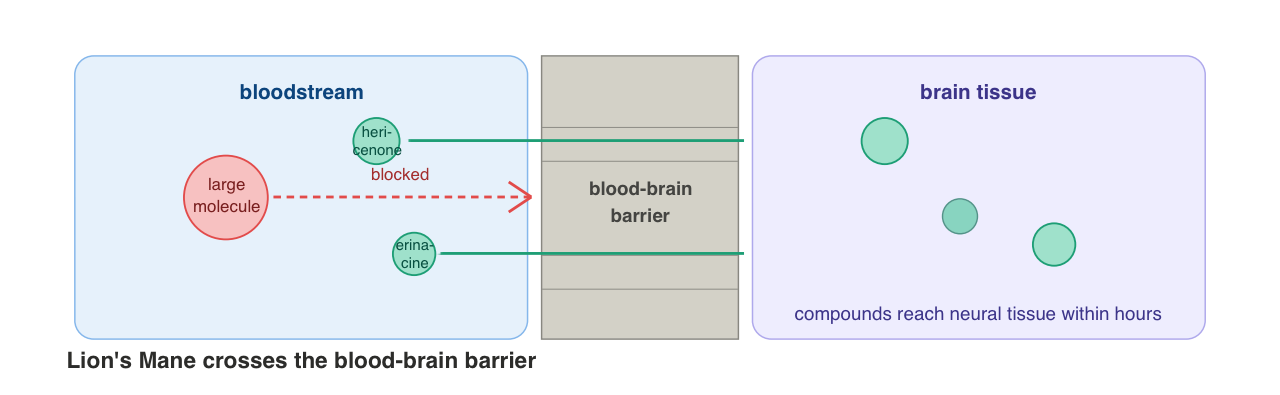
One of the biggest hurdles in brain health research is getting beneficial compounds past the blood-brain barrier—your brain’s selective security system that blocks most substances from entering neural tissue. This is where Lion’s Mane’s unique chemistry becomes particularly interesting.
Research suggests that two key compound groups in Lion’s Mane—hericenones and erinacines—have small enough molecular structures to cross this protective barrier. A 2020 study published in the Journal of Neurochemistry found that these bioactive compounds can be detected in brain tissue within hours of consumption, suggesting they successfully navigate this biological checkpoint that stops many other potentially beneficial substances.
What makes this even more compelling is that these compounds don’t just passively enter the brain—they appear to actively seek out and support neural tissue in ways that larger molecules simply cannot achieve.
Nerve Growth Factor: Your Brain’s Repair Signal
Perhaps the most significant mechanism behind Lion’s Mane’s brain benefits involves Nerve Growth Factor (NGF)—a protein that acts like a cellular repair signal for your nervous system. Think of NGF as your brain’s maintenance crew coordinator, directing the growth, maintenance, and survival of nerve cells.
Research indicates that hericenones and erinacines can stimulate the production of NGF by up to 5-fold in laboratory studies. This isn’t just academic curiosity—NGF plays crucial roles in neuroplasticity, the brain’s ability to form new neural connections throughout life. A 2019 study in the International Journal of Medicinal Mushrooms found that Lion’s Mane extract significantly increased NGF synthesis in both cultured neurons and animal models.
What’s particularly fascinating is that this NGF stimulation appears to be targeted. Rather than flooding the brain with growth signals, Lion’s Mane compounds seem to enhance NGF production specifically where it’s needed most—in areas showing signs of cellular stress or damage.
Neurogenesis vs Neuroprotection: Two Paths to Brain Health
Lion’s Mane appears to support brain health through two distinct but complementary mechanisms: neurogenesis (creating new brain cells) and neuroprotection (preserving existing ones).
The neurogenesis research is particularly intriguing. A landmark 2018 study in the Journal of Agricultural and Food Chemistry demonstrated that Lion’s Mane compounds could promote the growth of new neurons in the hippocampus—the brain region crucial for memory formation. The researchers found measurable increases in new neuron formation within just four weeks of supplementation in animal models.
On the neuroprotection front, research suggests Lion’s Mane compounds act as molecular shields, protecting existing neurons from oxidative stress and inflammatory damage. A 2020 study showed that erinacines could reduce markers of neuroinflammation by up to 40% in laboratory settings, potentially preserving cognitive function as we age.
Myelin Maintenance: Keeping Neural Highways Clear
Your brain’s neural networks depend on myelin—a fatty substance that wraps around nerve fibres like insulation on electrical wires. When myelin degrades, neural communication slows down, contributing to cognitive decline and neurological issues.
Research indicates that Lion’s Mane may support myelin maintenance through multiple pathways. Studies suggest that the mushroom’s compounds can stimulate oligodendrocytes—the cells responsible for producing and maintaining myelin. A 2014 study in the International Journal of Medicinal Mushrooms found that Lion’s Mane extract promoted myelin gene expression and supported the structural integrity of myelin sheaths.
This mechanism may explain why some research participants report improvements in processing speed and mental clarity after several months of consistent Lion’s Mane use. The myelin repair process is gradual, which aligns with the timeline many users experience for noticeable cognitive benefits.
Supporting Your Brain’s Chemical Messengers
Beyond structural support, Lion’s Mane appears to influence neurotransmitter systems, particularly acetylcholine—the brain chemical crucial for attention, learning, and memory. Research suggests that Lion’s Mane compounds may support healthy acetylcholine levels by protecting the enzymes responsible for its production.
A 2017 study found that participants taking Lion’s Mane extract showed improved performance on cognitive tests measuring attention and working memory. The researchers noted corresponding changes in acetylcholine activity, suggesting this neurotransmitter support contributes to the mushroom’s cognitive benefits.
This mechanism may be particularly relevant for memory formation and recall. Acetylcholine plays a key role in encoding new memories and retrieving stored information, which could explain why some Lion’s Mane research focuses on its potential for supporting memory function.
Realistic Timelines and Expectations
Understanding Lion’s Mane’s mechanisms helps set realistic expectations for benefits. Unlike stimulants that work within hours, Lion’s Mane’s neurobiological effects unfold over weeks to months.
Research suggests the timeline typically follows this pattern: NGF stimulation begins within days, but measurable increases in nerve growth and myelin maintenance may take 2-4 weeks. More significant neurogenesis and cognitive improvements often require 8-12 weeks of consistent use, reflecting the time needed for new neural connections to form and strengthen.
A 2019 clinical trial following participants for 16 weeks found that cognitive improvements continued to develop throughout the study period, with the most significant benefits emerging after 12 weeks. This suggests that Lion’s Mane’s brain benefits may compound over time rather than reaching a quick plateau.
Practical Implementation
If you’re considering Lion’s Mane, research suggests standardised extracts containing both hericenones and erinacines are most effective, typically at doses of 500-1000mg daily. Look for products that specify these active compounds rather than just total mushroom powder.
Taking Lion’s Mane with food may enhance absorption, and consistency appears more important than timing. Some people report better tolerance when starting with smaller doses and gradually increasing over 1-2 weeks.
The research paints a compelling picture of Lion’s Mane as more than just another supplement trend. Its ability to cross the blood-brain barrier, stimulate nerve growth factors, and support both neurogenesis and neuroprotection suggests a sophisticated approach to brain health that works with your body’s natural repair mechanisms rather than against them. While we’re still uncovering the full scope of its neurobiological effects, the existing evidence provides a solid foundation for understanding why this remarkable fungus has captured scientific attention.
_This information is for educational purposes only and not intended to diagnose, treat, cure or prevent any disease. Consult your healthcare provider before starting any new supplement, particularly if you have existing health conditions or take medications._
Group Forums
Discuss these articles by joining a Group
Latest Posts






Plantz is owned by Million Media Ltd, a registered UK company number: 15476153
Info
Membership
Notices
- Terms & Conditions
- Delivery Terms
- Privacy Policy
- Publishing Principles