
How We Estimated the Number of Medical Cannabis Patients in the UK: Full Methodology
How did Plantz estimate the number of medical cannabis patients in the UK? There is no official count — so we built one from government data, FOI disclosures, and independently verified industry sources. Here is exactly how.
Medical cannabis has been legal in the UK since November 2018. Yet no government body publishes a definitive count of how many patients are using it. So where do our figures come from, and how confident should you be in them?
This document explains our methodology in full. We believe transparency is the foundation of credibility. If you think we have made an error, we want to know. You can reach us and explore the underlying data at cannavec.ai.
The full Report (UK_medical_Cannabis_Patient_Numbers.pdf)
Why there is no official patient count
The absence of a central figure is not an oversight. It reflects how the private medical cannabis market is structured.
When a patient receives a private cannabis prescription in England, it is dispensed by a specialist pharmacy. The NHS Business Services Authority (NHSBSA) captures some of this dispensing activity — but it records items, not patients. An item is a single product line on a prescription form. One patient, at one appointment, may generate several items. The same patient may attend multiple appointments across a year. The NHSBSA has confirmed in its own Freedom of Information disclosures that patient counts are not held for private unlicensed prescribing.
The Medicines and Healthcare products Regulatory Agency (MHRA) has separately confirmed that it does not hold prescription-number data for cannabis-based products for medicinal use (CBPMs).
NHS England established a patient registry in April 2022, but no published UK-wide count from that registry has resolved the private-market question. The NHS side of the market — licensed cannabis-based medicines prescribed on the NHS — remains small by comparison and is not the focus of this analysis.
This means any patient estimate must be constructed, not simply retrieved. That is what we have done.
Our primary data source: NHSBSA Freedom of Information disclosures
The backbone of our analysis is official dispensing data from the NHSBSA, accessed via Freedom of Information requests and the NHSBSA Open Data Portal.
The key datasets are:
FOI-02725 — Private prescribing for unlicensed cannabis, monthly breakdown by product. This dataset covers November 2018 to late 2024 and provides item counts per month. Where monthly volumes were below five, the NHSBSA suppressed the figure. This affected January and February 2019 only.
FOI-03401 — Annual FOI providing total private unlicensed cannabis item counts for 2023 and 2024. These figures supersede monthly aggregations where discrepancies exist, because the annual FOI incorporates late-processed prescriptions that the monthly file may not yet reflect.
FOI-03623 — A product-level dataset covering January to July 2025. We aggregated this file to produce a partial 2025 figure. No official full-year 2025 total was published in the sources we reviewed.
From these sources, the official England private unlicensed cannabis item series is as follows:
| Period | Items | Confidence |
|---|---|---|
| Nov–Dec 2018 | 0 | High |
| 2019 | 272–280 | Medium-high |
| 2020 | 4,469 | High |
| 2021 | 43,933 | High |
| 2022 | 124,243 | High |
| 2023 | 282,920 | High |
| 2024 | 659,293 | High |
| Jan–Jul 2025 | 339,986 | Medium-high |
Two important caveats apply to this data. First, these figures cover England only. Private cannabis prescribing activity in Scotland, Wales and Northern Ireland is not captured in NHSBSA data. Second, the revision issue is real. The 2023 annual FOI figure differs from the sum of the 2023 monthly figures, because prescriptions processed after the monthly extraction are included in the annual total but not the earlier file. We use the annual FOI figure wherever it is available.
How we define “patient”
Before we could estimate patient numbers, we had to define what we were counting. This distinction is important, and we use it consistently throughout our figures.
Active patients are individuals currently receiving prescriptions — at a specific point in time. This is the most restrictive and probably the most useful figure for understanding the present state of the market.
Patients treated during a year are individuals who received at least one prescription in a given calendar year. This is a broader count. It includes people who started treatment, lapsed, and restarted within the same year.
Cumulative patients are all individuals ever prescribed medical cannabis since legalisation in November 2018. This is the largest number and the least useful for understanding current market size, since it includes people who have since stopped treatment.
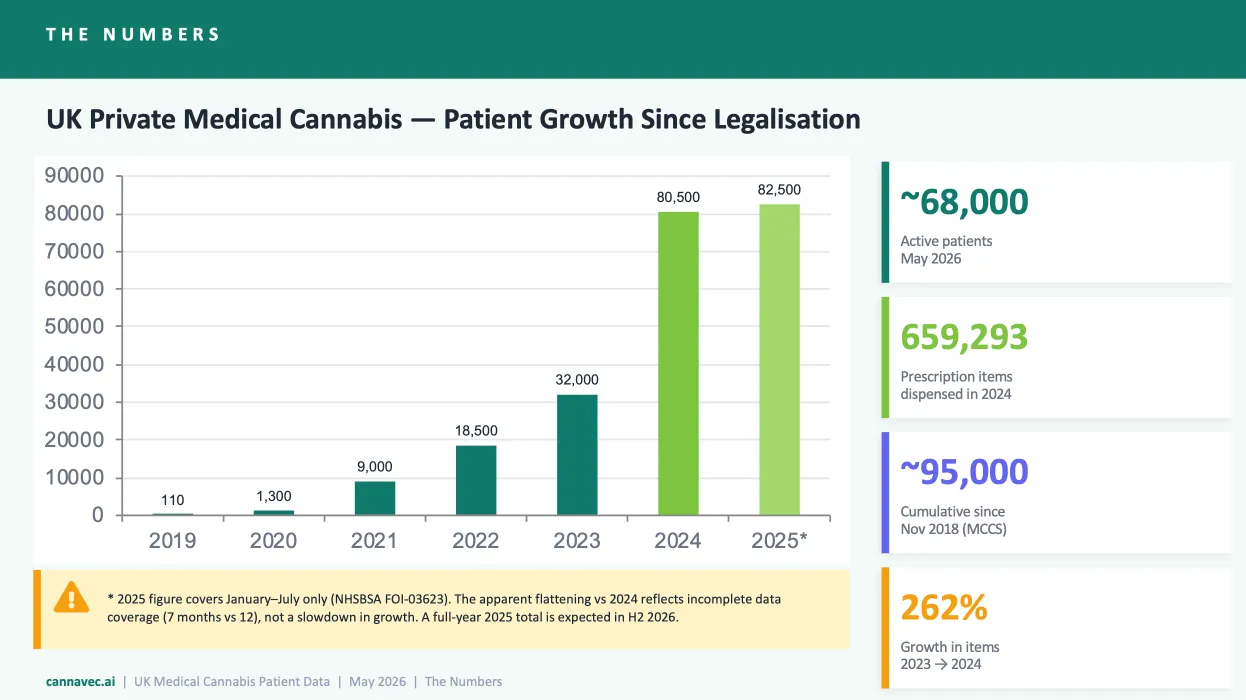
Our headline figures — around 60,000–75,000 active patients as of May 2026; around 75,000–90,000 treated during 2025; around 95,000 ever prescribed since 2018 — refer to each of these definitions respectively. They are not interchangeable.
Converting items into patients: the central challenge
Translating NHSBSA item counts into patient estimates requires an explicit conversion approach. We did not apply a single mechanical ratio across all years. Instead, we used a tiered approach that accounts for how the market has evolved.
In the early years of the market (2019–2021), prescribing patterns were less standardised. Clinics were still onboarding patients. Continuity of prescribing was lower. The ratio of items to patients was therefore different from the later, more mature market.
By 2023 and 2024, the market had matured. Patients were more likely to be on stable, repeat prescriptions. The typical patient was receiving multiple items per appointment across multiple appointments per year.
The clearest explicit UK conversion rule we identified came from the Medical Cannabis Clinicians Society (MCCS/UKMCCS), which argued in early 2026 that 659,000 items in 2024 equated to roughly 82,000 patients, based on a conservative average of approximately eight items per patient per year. We used this as one of four independent anchors, not as a universal rule applied mechanically.
Our four independent anchors
We triangulated item data against four published estimates from credible secondary sources. Each anchor was assessed for methodology transparency and proximity to primary data.
Anchor 1 — MCCS, February 2021. The Medical Cannabis Clinicians Society estimated approximately 3,000 patients had been prescribed privately since November 2018, as of early 2021. This figure is consistent with the NHSBSA item volumes for 2019 and 2020.
Anchor 2 — Cannabis Industry Council, 2023–2024. The CIC estimated around 20,000 private patients in mid-2023, rising to approximately 35,000 prescription cannabis patients across the UK by April 2024. These figures were published with reference to prescribing data and provided a useful cross-check against our item-based estimates for those years.
Anchor 3 — UKMCCS, 2024–2025. The UK Medical Cannabis Clinicians Society estimated 80,000–90,000 patients across the UK, based on 2024 item growth and the approximately eight-items-per-patient conversion ratio. This is one of the most methodologically transparent published estimates we found.
Anchor 4 — Prohibition Partners, 2025. Prohibition Partners, the specialist cannabis market research firm, estimated an active patient base of approximately 50,000–60,000 in 2025, with around 80,000 individuals expected to receive treatment during the year. Their UK Medical Cannabis White Paper 2025 was the most comprehensive secondary source we reviewed.
How we weighted sources
Not all sources carry equal weight. We applied a three-tier evidence hierarchy.
High confidence sources are official and verifiable. They include NHSBSA FOI disclosures and datasets, UK legislation and Home Office circulars, NHS England, NICE guidelines, Care Quality Commission guidance, MHRA correspondence, Health Canada data, and the Australian TGA. We used these to establish the official item series and the legal timeline.
Medium confidence sources are high-quality industry analyses that explicitly cite FOIs or primary data. We used these for patient-count anchors and market interpretation. The UKMCCS publications and Prohibition Partners White Paper sit in this tier.
Lower confidence sources are operator estimates and trade association statements without explicit primary data citations. We used these as sanity checks only — to assess whether our modelled ranges were plausible against what people inside the market were observing.
We did not treat any single industry estimate as canonical. Where sources disagreed, we chose ranges that were consistent with the official item spine rather than any one advocacy position.
Our resulting patient estimates
Applying the tiered conversion approach against the four anchors, our best estimates for patients treated during each year are:
| Year | Estimated UK patients (treated during year) | Confidence |
|---|---|---|
| 2019 | 80–140 | Low |
| 2020 | 1,000–1,600 | Low-medium |
| 2021 | 7,000–11,000 | Medium |
| 2022 | 15,000–22,000 | Medium |
| 2023 | 28,000–36,000 | Medium-high |
| 2024 | 73,000–88,000 | Medium-high |
| 2025 | 75,000–90,000 | Medium |
For active patients as of May 2026, we apply a further reduction. Patients treated during a year include those who entered or exited treatment across that period. The active patient stock at any point in time is lower than the annual treatment count. Our estimate of approximately 60,000–75,000 active patients reflects this distinction and sits between Prohibition Partners’ 2025 active-base estimate and the UKMCCS conversion of the 2024 item data.
The cumulative figure of approximately 95,000 people ever prescribed since 2018 draws on the UKMCCS April 2026 estimate published in their Good Practice guidance, which stated that 95,000 patients had received prescriptions since legalisation. This is a different and larger figure than the active patient count.
What this analysis does not capture
We are explicit about the limits of these estimates.
England only. NHSBSA data covers England. Private cannabis prescribing in Scotland, Wales and Northern Ireland is not systematically captured in the sources we reviewed. Our patient estimates therefore likely undercount UK-wide activity, though the England private market is by far the largest component.
No full-year 2025 official data. The most recent NHSBSA dataset we used covered January to July 2025. Our 2025 full-year estimate is a projection, not an official total.
No unique patient identifier. Because the NHSBSA does not hold patient counts for private unlicensed prescribing, we cannot identify how many distinct individuals are behind the item volumes. The items-to-patients conversion will always carry uncertainty.
International comparisons are methodologically distinct. Australia counts TGA approvals. Germany counted narcotic prescriptions before 2024, then import volumes after the Cannabis Act. Canada counts medical client registrations with federally licensed sellers. None of these maps cleanly onto the NHSBSA item concept. We used international data for policy impact analysis only — not for direct patient ratio conversion.
How to challenge these figures
We welcome scrutiny. If you believe our item-to-patient conversion is wrong, our source weighting is incorrect, or a more recent dataset supersedes ours, please tell us.
The full underlying research is accessible via our knowledge platform at cannavec.ai. Cannavec is Plantz’s evidence intelligence layer, built specifically to bring rigour and transparency to the UK and European cannabis data landscape. We update our knowledge base as new FOI disclosures are published and as the NHSBSA releases updated datasets.
If you are a researcher, journalist, or clinician with access to data we have not reviewed, we would welcome the conversation.
Key sources
- NHSBSA Open Data Portal — FOI-02725, FOI-03401, FOI-03623: opendata.nhsbsa.net
- UKMCCS Good Practice Guidance, April 2026: ukmccs.org
- UKMCCS: Medical Cannabis Prescriptions — The Facts Behind the Headlines: ukmccs.org
- Prohibition Partners UK Medical Cannabis White Paper 2025: prohibitionpartners.com
- Cannabis Industry Council: Cannabis Prescribing Report, 2023–2024: cicouncil.org.uk
- House of Commons Library, CBP-8355 — Medical Use of Cannabis: parliament.uk
- UK Government — Rescheduling of CBPMs, Home Office Circular 018/2018: gov.uk
- ACMD Call for Evidence on CBPMs, 2025: gov.uk
- Health Canada — Medical Purpose Cannabis Data: canada.ca
- Australian TGA — Medicinal Cannabis Review Consultation Paper, 2025: tga.gov.au
- German Federal Ministry of Health — Cannabis Act FAQ: bundesgesundheitsministerium.de
This analysis was produced by Plantz / Cannavec.ai. It is provided for informational purposes. It does not constitute medical or investment advice. Plantz operates an evidence-based knowledge platform for the medical cannabis and natural remedies sectors. Learn more at cannavec.ai.
Group Forums
Discuss these articles by joining a Group
Latest Posts






Plantz is owned by Million Media Ltd, a registered UK company number: 15476153
Info
Membership
Notices
- Terms & Conditions
- Delivery Terms
- Privacy Policy
- Publishing Principles